

We extend our sincere sympathy as you face the loss of your baby. Even though you never met him or her, he or she is a unique person created in the image and likeness of God. He or she does exist and there can be real sorrow as a result of your baby’s death. May God grant you comfort in your time of sorrow.
This page contains information on how to use resources you may have received through our efforts as well as other information that might be helpful to you.
No information that we provide is to be considered medical or legal advice.
Always inform your physician of your miscarriage and/or bleeding during pregnancy so that he or she can treat your appropriately. A miscarriage is a baby lost prior to 20 weeks gestation. All information here only applies to miscarriages.
There are different regulations for a stillborn baby which is born after 20 weeks.
Miscarriage Recovery Packet™
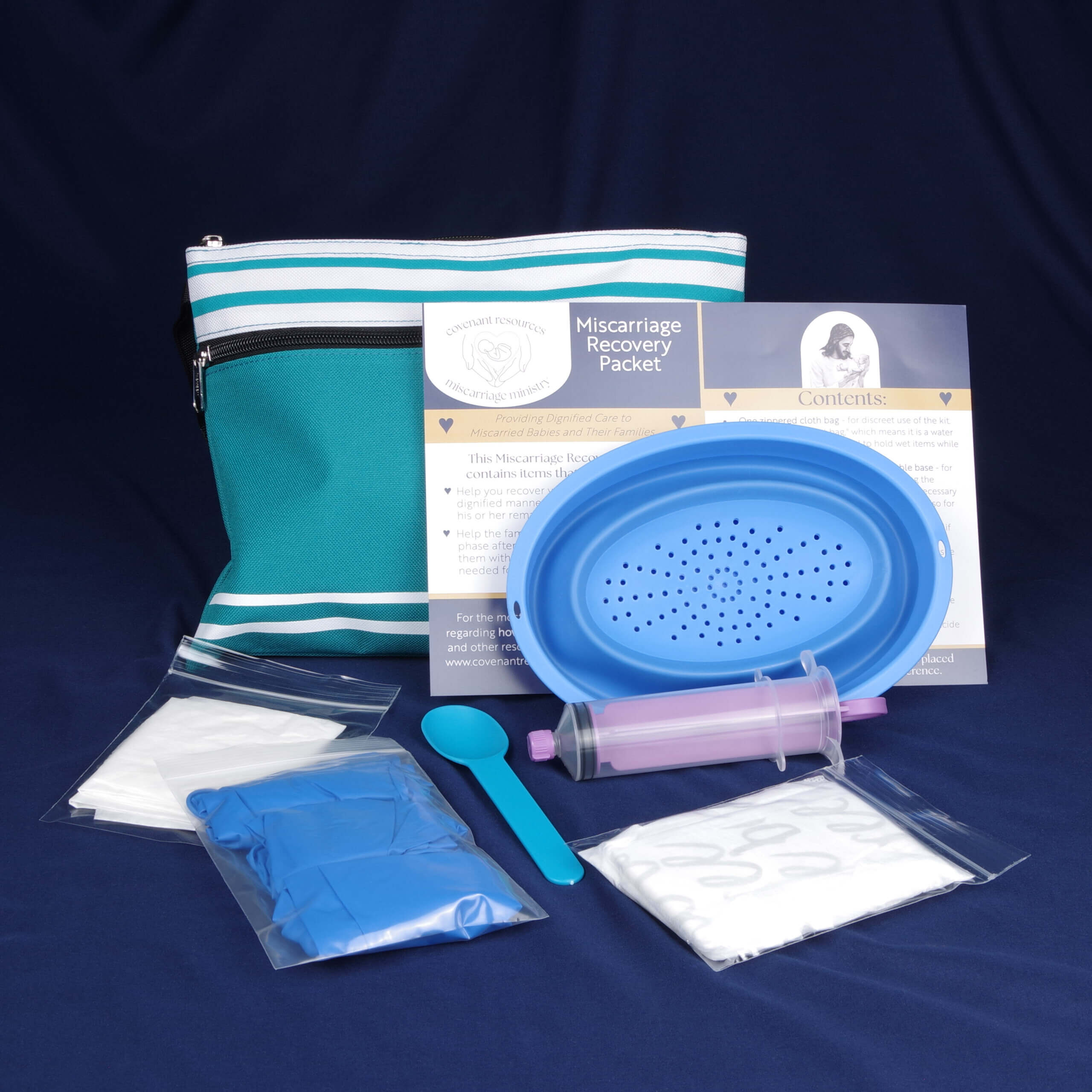
The Miscarriage Recovery Packet™ is a zippered, cloth bag that contains various items to assist at the moment of the miscarriage.
The Miscarriage Recovery Packet™ contains various items to help you recover your baby’s remains in a dignified manner after delivery and retain his or her remains for burial.
The Miscarriage Recovery Packet™ also helps the family in the recovery and healing phase after the miscarriage by providing them with the resources and information needed for the burial of their baby.
Inside the Packet, you will find:
- One zippered cloth bag – for discreet use of the kit. We wanted it to look like just a regular purse/handbag. It even has a second pocket for that purpose. The bag is also a “wet bag,” which means it is a water resistant bag that is designed to hold wet items while helping prevent leaks.
- One collapsible colander with removable base – for recovering your baby’s remains. It can also be used to measure blood loss if necessary.
- One 60 ml syringe – for cleaning your baby or measuring blood loss if necessary
- Two Sanitary Napkins – for the mother’s comfort if she has unexpected bleeding
- Three pair of gloves – for you, if you desire, or for someone who may be helping you
- Two Coffee Filters– for use inside the colander if desired
- Two plastic spoons – for lifting your baby out of the colander if assistance is needed. One is larger and either end can be used and the other is smaller, to give you three different shapes and sizes in order to meet whatever needs you might have.
- Small pair of scissors – to be used to cut the umbilical cord or open the amniotic sac if needed.
- Two non-adherent pads – for laying a small baby on for a picture outside the burial vessel if you desire. The baby’s skin will not stick to the pad and injure the skin. Also, it can be used to help support cutting the umbilical cord if needed. Place the umbilical cord on the pad and cut through both the umbilical cord and pad at the same time. This will help prevent the cord from folding over the scissors instead of cutting.
- One small empty plastic bag – for use if you decide to have testing done on the placenta.
You may want to also have normal saline or contact lens solution on hand for using in the burial vessel. This is not provided due to expiration dates.
You have two options for retaining your baby’s remains:
- Burial of all solid matter you pass if you are having an early miscarriage and may not see your baby
- Burial of just your baby if you are able to see his or her remains.
Miscarriage Recovery Packet™ Use Instructions
The following instructions will help guide you in using the Miscarriage Recovery Packet™. There is also a video at the end of these instructions to help further guide you.
Always notify your physician of your miscarriage or bleeding during pregnancy so that he or she can guide you regarding if you need to monitor blood loss, possible complications, or any other medical advice.
After you start bleeding, use the Miscarriage Recovery Packet™ every time you use the restroom.
1. Fully open the colander by gently pressing down in the center.
2. Remove the removable base from the colander to allow urine to pass through the colander but any solid matter or your baby’s remains to be retained in the colander.
3. Hold the colander under your vaginal area while using the restroom and/or potentially delivering your baby.
- If you are experiencing an early miscarriage, it may be difficult to find your baby. Some women collect any solid matter that is discharged and place it in a vessel for burial. You can use the coffee filter to prevent any matter from slipping through the holes in the colander. The coffee filter can also be used to lift your baby out of the colander while protecting his or her fragile skin.
- If you do not want to hold the colander while using the restroom, you can remove the removable base and place the colander in a urine specimen hat that you can obtain from your physician.
4. After each visit to the restroom, examine the contents in the colander to see if you have delivered your baby.
- It may be helpful to look at pictures of a baby that is your baby’s gestational age in order to better identify what your baby might look like and what size he or she may be.
5. If you have delivered your baby, take the colander to a sink.
- If you are burying any solid matter you pass, remove that matter from the colander and place it in your burial vessel even if you do not see your baby. You can use the enclosed spoon to assist you with this.
6. When you get to the sink, ensure that the removable base is removed from the colander.
7. Gently clean your baby using the syringe filled with water. The colander will hold your baby while allowing the rinse water to flow through.
- You can fill the syringe with water by drawing the water up out of a disposable cup or drawing water up out of a running stream coming from a faucet or by leaving the purple cap in place, removing the plunger, filling the barrel of the syringe and then replacing the plunger. You will need to remove the purple cap before use.
- If you tilt the plunger slightly as you do the final pull to remove it from the barrel, it will not make the popping sound that it makes when you pull it straight off.
8. After your baby is cleaned, place him or her in the burial vessel according to the instructions below.
9. If you decide to have testing done on the placenta, it is best to contact your physician to see how they would like the placental tissue stored and brought to the doctor’s office or hospital. If you are unable to contact the physician, place the placenta in the empty 4×6″ clear plastic bag. Then, store it in the refrigerator until you are able to take it to the hospital or doctor’s office.
10. After each use, rinse the colander and syringe and dry them. These items can then be placed in the plastic zippered bag and then in the zippered cloth dry bag in preparation for your next visit to the restroom.
Beware of using automatic flush toilets to prevent accidentally losing your baby if he or she is suddenly delivered while you are using the restroom.
To add subtitles in another language to this video in YouTube, open the video in YouTube and turn on the subtitles/close caption (you have to do this first or the gear icon will not give you the option you need). Then click on the gear and then subtitles/CC in that menu. Click on auto-translate and then select the desired language.
Monitoring Blood Loss/Variation in Use of the Miscarriage Recovery Packet™
Some physicians request that a woman monitor blood loss during a miscarriage. Other women monitor their blood loss on their own to report it to their physician.
If you need to monitor blood loss, add these additional steps to your use of the Miscarriage Recovery Packet™:
- Keep the colander’s removable base in place while using the colander in order to collect the blood that is lost.
- Do not urinate in the colander when you are measuring blood loss.
- You can use the syringe to remove the blood from the colander (with the removable base in place) and measure the amount of blood. Make sure you note, on a piece of paper or on your phone, the date and time the blood loss occurred and the amount.
- When you deliver your baby, make sure any blood is removed from the colander and measured with the syringe before your remove the removable base in order to clean your baby.
- After using the syringe to remove and measure blood loss, remove the plunger from the barrel and rinse in running water before using the syringe to clean your baby.
Burial Vessel and Wrap
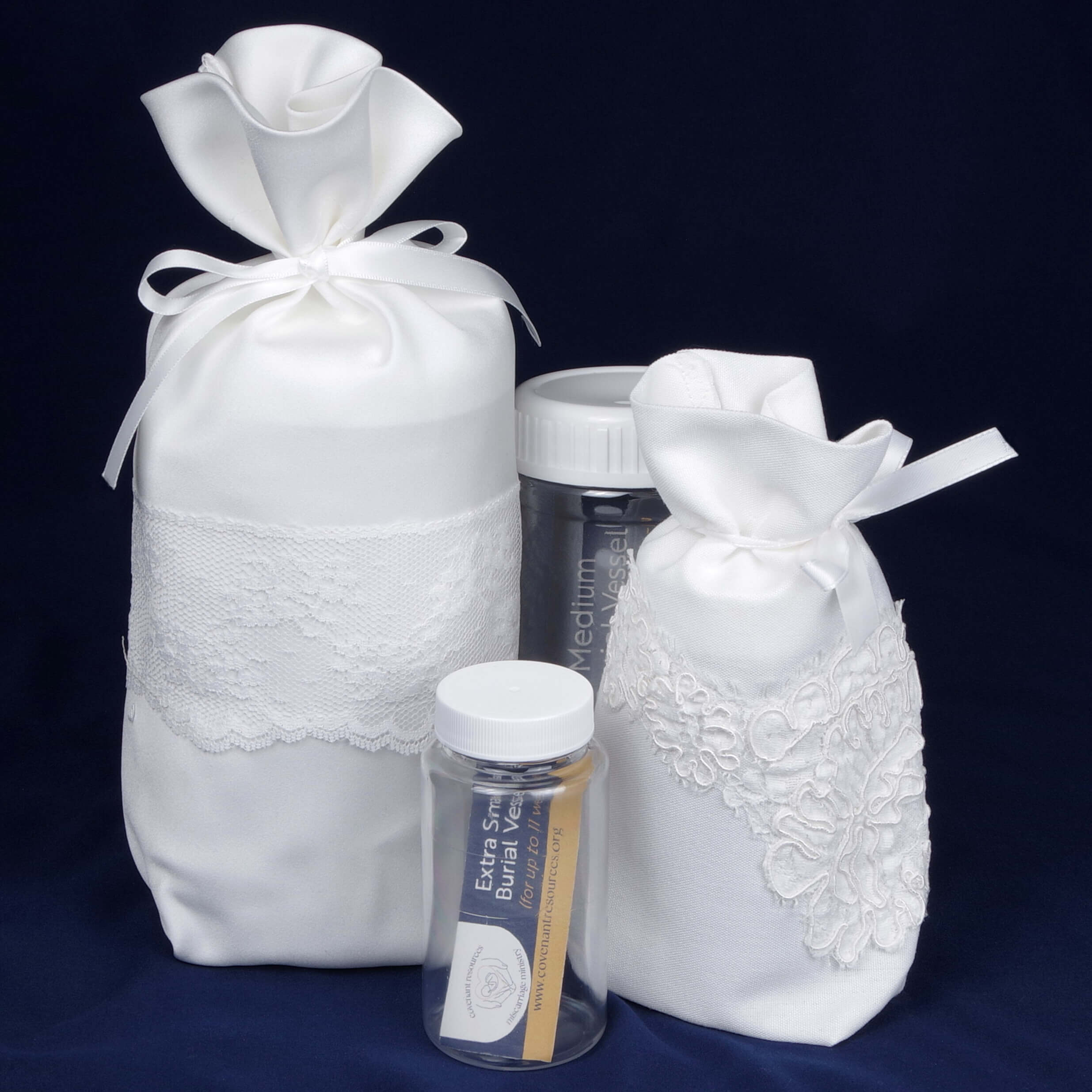
Because a small baby may have fragile skin and limited skeletal structure, this burial vessel enables the family to:
- Preserve their baby’s remains until burial.
- Allow family members to hold the baby without damaging the baby.
- Allow the family to take pictures of their precious little one.
After you deliver and clean your baby, fill the burial vessel part way with normal saline or contact lens solution. If you do not have any normal saline or contact lens solution available, you can temporarily use regular water until you can get some. The saline or solution will help preserver the baby better than regular water.
- If you have not found your baby and are burying any solid matter that is discharged, you do not need to fill the burial vessel with normal saline or contact lens solution.
Gently place your baby in the burial vessel
After the baby is placed in the burial vessel, you can finish filling the burial vessel with contact lens solution or normal saline.
Tightly replace the lid on the burial vessel.
The vessel wrap or sleeve allows you to discretely cover your baby’s remains if you desire.
If you desire, you can place the vessel containing your baby in the refrigerator to better preserve him or her until burial.
If you received a burial vessel and wrap or sleeve and your baby’s remains are in the care of a funeral home, give the vessel and wrap or sleeve to the funeral home so that they can place your baby in the burial vessel.
Burial of Your Baby
- If you miscarry at home and then go to the hospital or doctor for evaluation, it is recommended that you do not take your baby with you if you do not wish for testing to be done on the baby. This enables you to retain custody of your baby for burial.
- Even if your state allows you to bury your baby’s remains in your backyard, we always recommend that your baby be buried in an established cemetery. This enables you to continue to be able to visit your baby’s grave, even if you may move to a different home someday. You can find a listing of cemeteries we know about here.
- If you miscarry in a medical facility and they insist the baby be sent to pathology for testing, you are allowed to refuse that medical treatment for your baby if you desire to do so.
- You do not have to have your baby cremated for burial.
- If you would like other casket options in addition to the burial vessel, visit our resources page.
- You can also find more information on our Did You Know page.
Healing After a Miscarriage
Always ensure that your doctor is informed about your miscarriage or bleeding during pregnancy to ensure that you are physically healthy.
Some women desire peer support or counseling after a miscarriage. If you desire this, you can do an internet search for peer support or counseling specific for miscarriage. Your church leader may also know of a good place for peer support or counseling. You may also want to visit our resources page.
Covenant Resources Miscarriage Ministry™ offers Little Souls Memorial Ornaments and other books and gifts to provide mementos and closure after a miscarriage.
Covenant Resources Miscarriage Ministry™ also offers an annual Memorial Mass for Miscarried Babies. A recording of it is linked online each year and you can have your baby’s name read at the Mass if you would like.
This is Not My First Miscarriage–Is There Any Help?
Yes there is! NaProTECHNOLOGY and the Creighton Model FertilityCare System can help identify and treat causes of miscarriage and infertility.
Unlike, IVF or other artificial reproductive technologies, NaPro identifies and treats the underlying cause of the symptom of repeat miscarriage or infertility.
Because the underlying cause of miscarriage or infertility is treated, it is billed as the cause and not “infertility” and insurance will usually cover the cost treatment. It is also more effective than artificial reproductive technologies because it helps the woman’s body work the way it is supposed to instead of just trying to get her pregnant.
If you are interested, you can learn more about this here.
Questions?
If you have any questions during your miscarriage, feel free to call or text Covenant Resources Miscarriage Ministry™ at 812-212-3463.